
What Is GEO?
Generative Engine Optimization
GEO is the optimization discipline that makes your brand visible and cited as a source in AI answer engines like ChatGPT, Gemini, Perplexity and Google AI Overviews.
Users don't always get ten blue links anymore. They get a single answer. GEO is the art of being inside that answer.


Search has changed shape: people ask an AI a question and get back one composed answer. Only a handful of sources make it into that answer. If your brand is one of them, a new customer finds you without ever looking at a list of results. If it isn't, they hear a competitor's name instead. This guide goes through every signal we know of for winning one of those spots. It is written by the people who do the work.
Contents
Origins: The AIO Umbrella and GEO
A SHORT HISTORY: When AI answer engines arrived, we were one of the first agencies in the world to figure out how a brand gets into those answers, and we gave all of that work our own name: AIO, AI Optimization. We built the methodology, ran our test cycles, and applied it for our clients.
The industry and academia gave the generative-engine half of this work a different name: GEO, Generative Engine Optimization. A research team from Princeton and IIT Delhi coined the term in 2023; the paper went up on arXiv first and was presented at KDD 2024. The industry adopted the term, and so have we. Here is how we see it: AIO on top, GEO as one of the fields under it. This page covers that field under the industry's name, with the experience of people who do the work: you're reading GEO from one of the first teams in the world to practice it. Google's own guidance treats both acronyms the same way: it names AEO and GEO and says that optimizing for generative AI search is still SEO. SEO (Search Engine Optimization) sits under that same roof.
1 · Be Answerable
An answer engine looks for a passage it can lift and drop straight into an answer. So the first paragraph of every important page has to carry the topic and the answer on its own. Your headings should follow the questions people ask, and every question-and-answer block belongs in two places at once: the visible content and the schema. This guide is written that way itself.
2 · Tell the Machine Who You Are
AI cites the entity it recognizes. Organization and Person schema, sameAs links, and brand details that match everywhere on the web are your ID. They are what shows a machine who you are. A brand with a weak entity graph gets skipped even when the content is good.
3 · Keep the Door Open
The best content in the world counts for nothing if a machine can't read it. Your full text has to be in the raw HTML, and robots.txt has to hold the door open for GPTBot and crawlers like it. Google's own documentation on AI features is here.
The Anatomy of an AI Answer
The quickest way to understand GEO is to pull apart what an answer engine produces. An answer engine is a system that writes you a reply instead of listing links, and a typical reply has three layers. Your brand enters each layer through a different signal:

"Is there a reliable SEO checklist for company websites?"
Yes. On a company website an audit starts with a technical crawl and runs through a nine-step checklist. The list covers raw HTML access, bot permissions, structured data and answerable headings1; for worked examples, see the industry guides2.
The direct answer (indigo): the engine's opening line. It comes from your self-contained intro paragraph.
The reasoning (amber): the supporting passages. This is where your answerable sections get pulled in.
Source citations (1, 2): the real contest. Getting into those slots is what GEO is about.
Notice that this answer holds only two sources. In classic SEO, position 7 still gets traffic. In GEO, if you don't make the answer, you don't exist. That is why every single signal below counts.
Proof: Google's Own Summary Cites Us
Everything on this page comes down to one test: does the AI cite you? Search Google for the Turkish phrase for AI Optimization. The AI Overview that comes up names two sources as it explains the concept: Google for Developers and the Türk SEM AIO page. The screenshot is from September 2026. The interface is Turkish; the mechanism is the same in every index. We walked through how it happened in our AI Overviews guide.
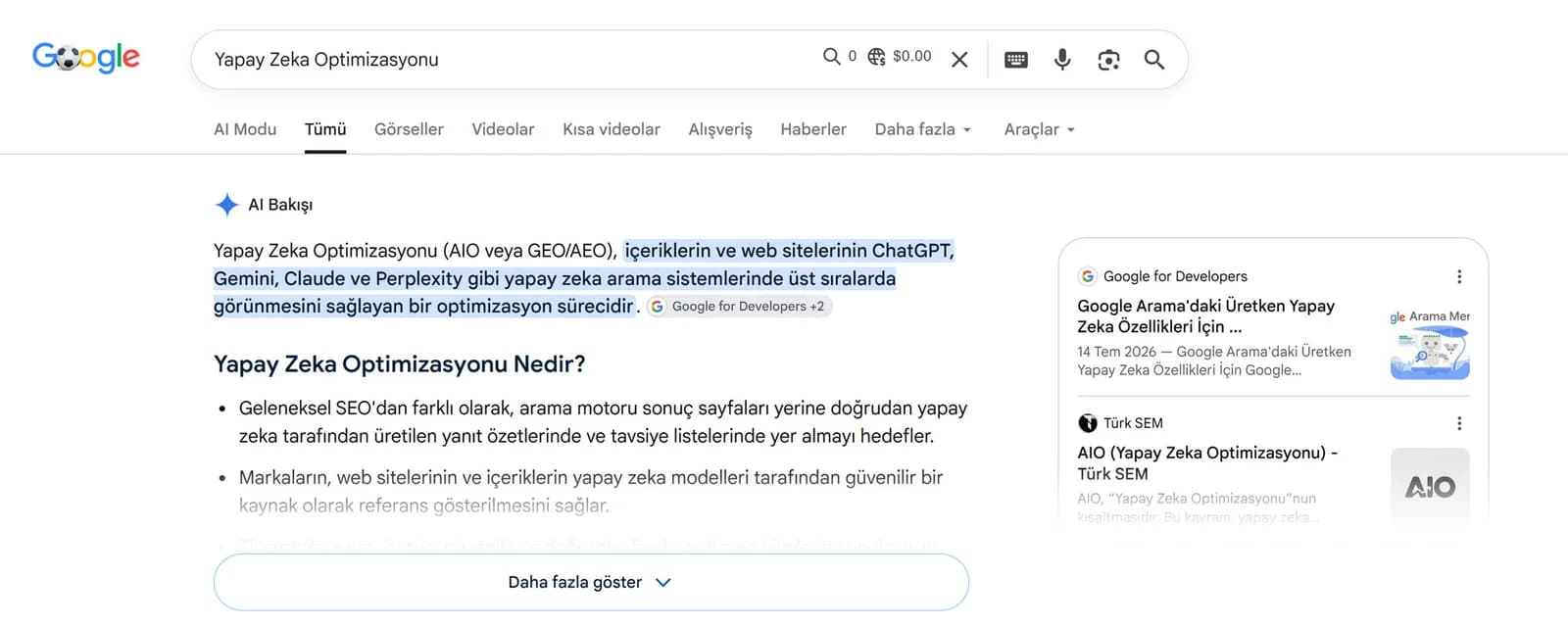
The second piece of evidence is from Search Console: between June and September 2026, turksem.com recorded 30.8K impressions in Google's generative AI features. We publish the number for a plain reason: when you open your own report, you have something to compare it against.
GEO in Numbers
Four measurements explain why GEO matters now. Each carries its source, and none of them is ours.
68%
US Google searches that ended without a click to any website, January to April 2026
SparkToro, Similarweb panel
8% / 15%
Share of visits with a click on a result, with and without an AI summary on the page
Pew Research Center, 68,879 real searches
30%
Domains cited by AI Overviews that do not appear on page one of the results for the same query
Washington University in St. Louis, arXiv 2026
38%
Share of cited sources that also rank in the top 10 for the query; it was 76% in July 2025
Ahrefs, 863,000 keywords
The last two numbers are the whole point of GEO: you can be cited without ranking on page one, and you can rank first without being cited. The full picture of the lost clicks is in our zero-click search article.
RANKING IS GOOD. BEING CITED IS STRONGER.
Answer engines don't look for the biggest brand. They look for the best answer.
The principle we've argued for years in SEO only gets sharper in GEO: you don't build a website for Google; you build it for people. The content that gives a reader the clearest, most useful, most honest answer is the same content an AI wants to cite. So GEO is not a list of tricks. It is the work of building the best answer in your industry.
The Differences Between GEO and SEO
The two disciplines aren't rivals, they are layers: SEO makes you findable, GEO carries you into the answer. Here is how they differ on six points:

Result format
SEO: Ten blue links, and the user picks one.
GEO: One written answer. Your site is either the source behind it or it may as well not exist.
Success metric
SEO: Ranking and clicks (position, CTR).
GEO: Citations. Your brand appears in the answer and is named as a source.
Content unit
SEO: The whole page is judged against a keyword.
GEO: The passage and the sentence. The engine hunts for a self-contained section it can lift.
Identity signal
SEO: Keywords and backlinks carry the weight.
GEO: Entities carry the weight. Structured data proves who your brand is.
Technical foundation
SEO: Crawlability and indexability.
GEO: Readable raw HTML and an open door for AI bots. Most answer engines never run JavaScript.
The competitive arena
SEO: A results page has ten spots.
GEO: An answer usually cites two or three sources. Higher bar, bigger payoff.
How Do AI Engines Choose a Source?
An answer engine's choice of source can look arbitrary. The signals behind it are not. These eight signals are our field methodology, boiled down:

Content in raw HTML
Most answer engines don't run JavaScript. If your content isn't in the raw HTML, it doesn't exist for AI. Server-side rendering is where GEO starts.
An open door for AI bots
Block GPTBot, ClaudeBot and PerplexityBot in robots.txt and you can never be a source. Access is a deliberate choice, and a site that wants GEO opens the door.
Answerable structure
A self-contained intro paragraph, a clear heading hierarchy, question-and-answer blocks. The engine reaches for the passage it can lift straight into an answer.
The entity graph
Organization, Person and sameAs markup tell the machine who your brand is. AI cites the entity it recognizes and walks past the one it doesn't.
Structured data
JSON-LD schema (Article, FAQPage, Product...) settles the question of what your content is. Make the engine's job easier and you move ahead of the site that doesn't.
Answer the sub-questions too
Google builds its summary from the parts of a question, not from the single query you typed; the process is called query fan-out. For someone asking "is it worth it?" the system also searches for the time, the cost and the conditions in the background. The page that answers most of those under its own subheadings becomes a source. The page that answers only the main question usually gets left out.
Authority and citations
AI models learn the brands that trusted publications name. Show up consistently in the outlets that matter and you end up in the training data.
Consistency and freshness
Your name, address and service description have to match everywhere. Contradictions cost you citations, and content kept current is content that gets picked.
Platform Differences
The signals are the same everywhere, but each answer engine picks and displays its sources in its own way. Knowing how the three big platforms behave sets your expectations straight:
ChatGPT
Conversation first
It builds the answer into the flow of the conversation, searches the web when it needs to, and lists sources at the end or when you ask for them. It knows your brand from its training data and from live search at the same time. That is why a consistent entity across authoritative publications is the most durable signal here.
Google AI Overviews
Woven into search
The summary sits above the classic results and the source cards are easy to spot. It runs hand in hand with Google's index and ranking signals, so this is where your classic SEO foundation pays off most: a fast, crawlable site with clean structured data has the edge.
Perplexity
Born an answer engine
Built as an answer engine from day one. It attaches a numbered citation to almost every sentence, and the source list is part of the answer rather than a footnote. This is where you can see where you stand most clearly, and where answerable passages pay off fastest.
GEO + SEO = VISIBILITY
GEO for Business Owners: Seven Questions
This part is not for your SEO team. It is for the person who owns the business. An agency or a web team does the technical work; the seven questions below can only be answered by you, and GEO work that starts before they are answered is built on sand.

Can you describe your company in one sentence?
When an AI describes you, it writes one sentence. If you do not supply that sentence, it makes one up, and in that sentence you look exactly like your competitor. Fit three things into one line: what you do better than anyone, the objective proof (a measured time, a certification, a capacity, a customer count), and who it is for. That line becomes the first paragraph of your site.
What does your customer ask before buying?
Write down the twenty questions you hear most on the phone, in the store and by email: price, timing, warranty, fit, comparisons. An answer engine receives exactly those questions and cites the site that answers them. The list shows you which pages your site is missing.
Does your site answer them?
A product or service page is no longer enough. How to choose, how to maintain, when it is the wrong fit, which one suits whom: the page that teaches gets cited, the page that sells does not. Your company website is the heart of your business, and the company that shares its knowledge there is the one that ends up inside the answer.
Do you say the same thing everywhere?
One address on your site, another on your Google Business Profile, an old phone number in a directory. An AI sees the mismatch and trusts you less. Name, address, phone, service description and founding year should match word for word everywhere; close or fix the stale listings.
What does AI say about you today?
You do not need an agency to measure this. Ask ChatGPT, Gemini and Google about your company by name, then ask them the three basic questions in your field. Are you mentioned, is it accurate, is a competitor named instead? Take screenshots. That is the starting line, and six months from now it is your yardstick.
Is the door open?
Ask your web team one question: can AI crawlers reach our site? Some infrastructure, Cloudflare included, closes that door by default. If it is closed, everything above is wasted; you cannot appear in any answer. Do not spend money on anything else until the answer is yes.
What should you ask before signing?
Three questions are enough. Which questions will you track, and when do I see the first measurement? What will you use for reporting, and does that include the generative AI report in Search Console? Do you guarantee results? We suggest dropping any offer that says yes to the last one; nobody owns the system that writes the answer.
If you want to learn the discipline
You're in the right place: this page covers what GEO is, the signals behind it and the seven questions only a business owner can answer. To see where it sits in digital marketing as a whole, read our Digital Marketing guide.
If you're curious about the methodology
The umbrella above GEO is called AIO. It has seven steps: discovery and question mapping, entity and identity consistency, answerable content, citable assets, technical openness, a test-and-measure cycle, and an authority and learning loop. GEO is one field of work under it.
The AIO methodology →PROVE IT
Put it in writing. The Türk SEM Academy GEO certification tests your command of AI search across ten topics. The exam and the certificate are free, and the verification page is open to anyone.
GEO Certification →2026: Answer Engines Are Maturing
GEO Is No Longer an Experiment. It's a Channel.
AI Overviews passed 2.5 billion monthly users by May 2026, and since August 31, 2026 every Search Console property carries a generative AI report. Visibility is now something you measure, not something you guess. The early-mover advantage still holds: in most industries, nobody has claimed the spots yet. You can plan what this channel returns with our ROI approach.
Frequently Asked Questions
What is GEO (generative engine optimization)?
GEO (Generative Engine Optimization) is the optimization discipline that makes a brand visible, and cited as a source, in generative AI answer engines such as ChatGPT, Gemini, Perplexity and Google AI Overviews. The word "generative" is the point: these systems do not hand you a list of links. They write the answer themselves and pick a few sources while they write it.
In classic SEO the goal was a ranking, and even the tenth result collected some traffic. In GEO the goal is a place inside the written answer. Most answers hold two or three sources; the ones that make it in are visible, the ones that do not are simply absent. That is why GEO is not an extension of ranking tricks. It is the discipline of being answerable.
Who coined the term GEO, and when did it start?
A research team from Princeton and IIT Delhi coined it in a paper posted to arXiv in November 2023 and presented at KDD 2024, the ACM's data mining conference. The paper measured how changes to a page, such as adding citations, statistics and quotations, changed how often generative engines used it. The name stuck within a year.
The practice is older than the name. Agencies were already figuring out how to get brands into AI answers in 2023, and we were one of them; we called all of that work AIO and still do. Google's own guidance now names GEO and AEO together and says the work is still SEO, which is a fair description of where the field settled.
What is the difference between GEO and SEO?
SEO gets you ranked in a list of results. GEO gets you into the answer an AI writes. The difference shows up in three places. The metric changes: rank and clicks in SEO, mentions and citations in GEO. The unit changes: SEO judges the whole page against a keyword, GEO judges a single passage, sometimes a single sentence, on whether it can be lifted into an answer.
The arena changes too: a results page has ten spots, an answer has two or three. So the bar is higher in GEO and the payoff is bigger. But the two are layers, not rivals: a site that cannot be crawled and indexed cannot be cited either. The six-point table above walks through the rest.
GEO vs AEO vs AIO: what is the difference?
They overlap more than they differ, and most of the time they describe the same work. AIO is our umbrella: strategy, measurement, test cycles and authority building in one frame. GEO is the field under it that faces generative engines: being a source in what ChatGPT, Gemini, Perplexity and AI Overviews write. AEO is the industry's name for optimizing for answer engines, and Google's guidance treats AEO and GEO the same way and calls both of them SEO.
The confusion has a specific cause: Google's AI Overviews feature is also shortened to "AIO" in the industry. Our AIO is the name of a methodology; Google's is a feature. We counted how often each term gets used, with Google Trends data, in a separate article linked in the sidebar.
Does GEO replace SEO?
No. GEO is built on top of SEO. Before an answer engine can cite a page it has to find it, crawl it and read it. Google's AI Overviews draw directly on Google's index, and ChatGPT runs a web search when it needs current information. A page that is not indexed reaches neither of them.
Getting this right means running two layers at once: SEO for the Google ranking, GEO for the citation in an answer engine. Google's own guidance says the same thing in one line: optimizing for generative AI search is still SEO. That is also why we do not sell GEO as a separate service; it runs inside the SEO work.
How do you do generative engine optimization?
In order, without skipping the foundation. First, the technical foundation: content readable in raw HTML and an open door for AI crawlers. Then answerable content: every important page gives the answer in its first paragraph and covers the customer's sub-questions (time, cost, conditions, exceptions) under their own subheadings.
Then identity: Organization and Person schema, and the same brand facts everywhere. Then authority: being named in the right context by the publications your industry trusts, through real mentions rather than paid lists. Measurement comes last: the generative AI report in Search Console and a regular test of your own target questions. The part that belongs to you as the owner is the seven questions in the section above.
How do you measure and track GEO?
On two levels. First, technical readiness: raw HTML access, bot permissions, answerability, structured data. These are yes-or-no questions and take a week to check. Second, real visibility: is your brand mentioned in AI answers, is it described correctly, and for which questions?
For the second level there is finally an official tool. The generative AI report in Search Console shows your impressions in AI Overviews and AI Mode, and it has been open to every property since August 31, 2026. It does not show clicks or queries; you cover the query side by testing your own target questions the same way every month. Fill out the form on this page and our team will check where your brand stands today.
Do I need an llms.txt file?
Google's guidance says plainly that you do not. There is no special file and no special format for appearing in AI Overviews; the two requirements are that the page is indexed and eligible for a snippet. We have no evidence that other engines read llms.txt either, and we have not seen a study that shows it.
It does no harm. Publish one if you like, but keep it at the bottom of the list and do not let it take time away from content. The real signal is the content itself: a page that answers in the first paragraph, covers the sub-questions and stays consistent. A site without llms.txt but with the answer gets cited. The reverse does not happen.
What if an AI engine gets my brand wrong?
First, the wrong sentence is not invented; the system read it somewhere. Find where. Does the description on your site agree with your Google Business Profile, your directory listings and your press coverage? Is an old page still live? Is a closed location still listed somewhere? Most errors about a brand come from those mismatches.
Then fix the source: update your Organization schema, redirect stale pages, close or correct the directory entries. On Google, use the feedback link under the summary; it does not act immediately, but it is recorded. A consistent source is the only way the wrong sentence gets corrected the next time the answer is generated. The system does not correct itself.
How do I get cited in ChatGPT?
ChatGPT knows you from two places. The first is its training data: it knows your brand the way the texts it learned from described it. For that you need consistent mentions in authoritative publications, trade media and trusted directories; it does not happen overnight, it accumulates. The second is live web search: when a question needs current information, ChatGPT searches at that moment and cites the pages it finds.
The second path has two conditions: GPTBot has to be able to reach your site, and your page has to give the answer in the first paragraph. A closed door cancels both, so check robots.txt first. If you run behind Cloudflare, know that its default setting blocks AI crawlers, and check it.
How long does it take to see results?
A fixed timeline would be dishonest, and you should be careful with any offer that gives you one. But you can break it into levels. Technical readiness improves fast: opening the door, adding schema and rewriting a first paragraph are a week's work, and the effect can show up in Google's AI Overviews within a few weeks.
It takes longer for a model to really learn your brand and get in the habit of citing it. That builds over months, with your content and your authority. Getting into ChatGPT's training data waits for the next model version. That is why you take the first measurement early: six months from now you can only see what changed if you know where you started.
Can a small business compete in GEO?
Yes, and that is exactly where the window of opportunity sits. Answer engines do not look for the biggest brand, they look for the best answer. The measurements bear this out: roughly a third of the domains cited by AI Overviews do not even appear in the first-page results for the same query. A site that cannot reach page one can still be cited if it gives the right answer to the right question.
The small site's advantage is focus: a niche topic, a question customers actually ask, an answer written from experience. With clean structured data, consistent details everywhere and the answer in the first paragraph, a small site can be cited ahead of competitors many times its size. Most large sites are not doing this work yet, which is why the window is open.
Do you guarantee a place in AI answers?
No, and nobody can. The system writing the answer is not ours, and it decides which sources to use every time it runs. It can show you one day and your competitor the next for the same question. That uncertainty is the nature of the system, not a gap in our work.
What we commit to is specific and measurable: checking off the signals one by one, measuring visibility on your target questions every month with the same method, and reporting what we find, as is, in good months and bad. Treat any offer that guarantees AI rankings with caution: either they are not measuring, or they are not showing you what they measured.
Is GEO different for ecommerce?
The base is the same, with two differences. First, data: when an answer engine describes your product it also states the price, the stock status and the delivery time, and it will quote a stale figure with the same confidence as a current one. Keep price and stock current, mark them up with Product schema, and let category pages answer "which one is right for whom." A product page alone rarely gets cited; a buying guide does.
Second, the horizon: agent shopping protocols have been arriving since late 2025, and the agent does not just find and compare the product, it places the order. There is no single standard yet, but your product feed should already be in a form a machine can read. The details are in our ecommerce SEO guide.
GEO Assessment · Free
Get Inside the Answer
Getting into AI answers starts with one step. Let's look at where your brand stands in AI answers today, then close the gaps in your signals one by one.
Leave your company name and the phone number of the person we should call. Our team will look into how visible your brand is in AI answer engines, then call back with what we find.