In August 2026, a federal judge in Washington listened to Google explain why its AI summaries are good for publishers, and said from the bench that the arrangement "seems really unfair." That hearing is the clearest sign of where AI Overviews now sits in the United States: not in a marketing debate, but in court.
You are probably here for a simpler reason. You run a website, your traffic is down, and you want to know what the box at the top of the results page did to it. This article answers that with the litigation record, US measurements, Google's own documentation and our own Search Console numbers.
First, the names
Google calls the summary AI Overviews and the separate conversational tab AI Mode. The industry also shortens AI Overviews to "AIO." Our AIO means AI Optimization, the name of our methodology. Two different things. In this article, Google's feature is always AI Overviews; when we write AIO, we mean our own umbrella.
The Cases Now in Front of the Courts
Two companies have sued Google over AI Overviews, and both chose antitrust rather than copyright.
The docket
- Chegg v. Google, February 2025: the first antitrust suit by a single company over AI Overviews. Chegg argued that Google requires companies to supply content in order to appear in search, then uses that content in its own answers.
- Penske Media v. Google, September 2025: the owner of Rolling Stone, Variety, Billboard and Deadline made the same structural argument. The claim is not copyright infringement; it is that Google makes visibility in search conditional on letting Google reuse publisher content in AI features.
- The hearing, August 2026: Google moved to dismiss in January 2026 and argued the motion before Judge Amit Mehta, the same judge who ruled on the search monopoly. His "seems really unfair" is a remark, not a ruling, but it tells you where the pressure sits.
- The remedies, September 2025: in the government's search antitrust case the court ordered behavioral relief, data sharing, no breakup and no divestiture of Chrome. The government appealed in February 2026.
Nothing is settled. What did change, and it came from Britain rather than a US court, is the opt-out: under an order from the UK competition regulator, Google opened a toggle in Search Console in June 2026 that removes a site from AI Overviews, AI Mode and the AI summaries in Discover, worldwide.
Read the trade before you take it
Opting out does not restore your clicks. It removes you from the surfaces where those clicks are now decided, and your competitor stays in the box. The lawsuits are about who owes whom; the toggle is about whether you appear at all. Those are separate questions, and only the second one is yours to answer this week.
What the Numbers Show
The US has had AI Overviews since May 14, 2024, longer than any other market, so the measurements here are the deepest in the world.
Four measurements
- Pew Research Center, July 2025, about 68,000 real searches: with an AI summary on the page, users clicked a result 8% of the time; without one, 15%. Only 1% clicked a source inside the summary.
- Chartbeat, cited by the Reuters Institute: organic search traffic across roughly 2,500 US publisher sites fell 38% between November 2024 and November 2025.
- Similarweb: zero-click searches rose from 56% to 69% between May 2024 and May 2025, and publishers' combined organic traffic slid from 2.3 billion to 1.7 billion monthly visits.
- Ahrefs: when an AI Overview appears, the click-through rate for position 1 fell 34.5% in April 2025 and 58% by December 2025.
Individual names make it concrete. The Wall Street Journal, working from Semrush data, reported that USA Today's organic Google traffic fell by nearly half year over year. CNN fell about 25%, Politico 23%, and Business Insider more than 85%.
The message in those numbers is blunt: ranking first is no longer a traffic guarantee. The summary answers the question before anyone reaches your page. People who still click have already decided, which means you get fewer visitors and each one is worth more. The box at the top decides who gets them.
A Refresher on What the Box Actually Is
AI Overviews are automatically generated summaries at the top of the search results page. They sit below the ads and above the organic listings. Google pulls information from several sources, writes a few paragraphs, and links the pages it used. By Google's own account, a summary shows up when a question needs information from more than one source.
Note: AI Overviews and AI Mode are not the same
AI Overviews appear on their own at the top of the normal results page; you search, the summary is there. AI Mode is a separate tab. Click it and search becomes a conversation: you ask, then follow up. AI Mode reached Search Labs in March 2025 and opened to every US searcher on June 27, 2025. Google says AI Overviews now reaches 2.5 billion users a month.
| Feature | Classic organic result | AI Overviews | AI Mode |
|---|---|---|---|
| Position | Below the ads and the AI summary | Top block, default view | Separate tab |
| Trigger | Every search | Informational queries, automatically | The user clicks in |
| Interaction | One click, one direction | Fixed summary with source cards | Multi-turn conversation |
| Clicks | High volume, spread across many results | Fewer, better qualified | Fewest clicks out, built for exploring |
How AI Overviews Picks Its Sources
Google has described the mechanism, so you do not have to guess. The system breaks your query into sub-questions. It runs a separate search for each one. Pages that show up across those searches become sources. The summary is not assembled from the top ten results of one search; it is assembled from the results of many small ones.
Note: query fan-out
Someone searches "is a heat pump worth it." The system opens that into sub-questions: "heat pump payback period," "heat pump vs furnace cost," "heat pump cost to install," "heat pumps in cold climates." It searches each separately.
The result: a page that answers all four with its own subheadings becomes a source. A page that spends two paragraphs on "is it worth it" does not.
The consequences are measurable. In July 2025, Ahrefs found that 76% of cited pages also ranked in the top ten for the same query. By the March 2026 study, across 863,000 keywords and 4 million URLs, that had fallen to 38%. Nearly a third of cited pages do not rank in the top 100 at all. A typical overview cites eleven sources and finds them well beyond page one.
What the summary does not care about is length. In the January 2026 Ahrefs analysis of 146 million search results, the correlation between word count and citation is close to zero. Your thousand-word page is not at a disadvantage compared with a two-thousand-word one. What counts is the answer being in the right place.
Our own observation
From our work: the system already has an answer in mind. It looks for the pages that match that answer and cites the ones closest to it. Google crawls the whole web anyway and prepares for questions before they are asked. So two things decide whether the summary cites you: whether your page agrees with the published evidence, and how strict you are about accuracy. The more distance you keep from speculative claims, the more you are worth as a source. This is our own view, and we may be wrong about it.
The "Best Of" List Problem
In 2003, SEO was simple and its logic was easy to exploit. GEO is in the same place today. Much of today's GEO advice rests on one thing: "best of" lists someone assembled without stating a single criterion. Those lists are cheap for a model to process, which is why they get cited right now.
The problem is not the list. It is the missing variable behind the ranking. Take a "best XYZ" list. If the order rests on something measurable (production volume in tons, a tested result, a published benchmark), the ranking carries information. If it rests on an opinion, it carries none. As AI systems get better at ranking companies, products and services, a large share of today's paid placements will amount to nothing. We are confident about that part.
In the US there is a second reason to stay off these lists. The Federal Trade Commission requires paid placement to be disclosed, and a page marked as sponsored is a weaker source. That is the right outcome. We do not buy our way onto those lists and we advise you not to either. That is our read on it; the future may not go the way we describe.
What Google Requires, and What It Does Not
Google's guide for site owners was updated in July 2026, and two of its statements are unambiguous. First: optimizing for generative AI search is optimizing for the search experience, and therefore it is still SEO. Second: there is no extra requirement and no special optimization for appearing in AI Overviews or AI Mode. There are two conditions: the page has to be indexed, and it has to be eligible to appear with a snippet.
Not needed
- Special files such as llms.txt.
- Chunking your content into fragments.
- Rewriting existing pages just for AI systems.
- Manufacturing mentions; it does not work.
- Piling on structured data beyond what the page needs.
Google's own documents
Go to the source. All five are Google's:
- Optimizing your website for generative AI features on Google Search: the "still SEO" line and the list of misconceptions.
- AI features and your website: how AI Overviews and AI Mode work, how sources are chosen, what makes a page eligible.
- Control your snippets in search results: nosnippet, data-nosnippet and max-snippet.
- Search Console: generative AI performance report: what the report shows and what it withholds.
- Search Central blog: the report announcement, June 2026.
Measuring: The Generative AI Report in Search Console
For a long time there was no way to tell whether you appeared in AI Overviews; everyone was guessing. That ended. Google announced the report on June 3, 2026, and since August 31 it has been available to every site.
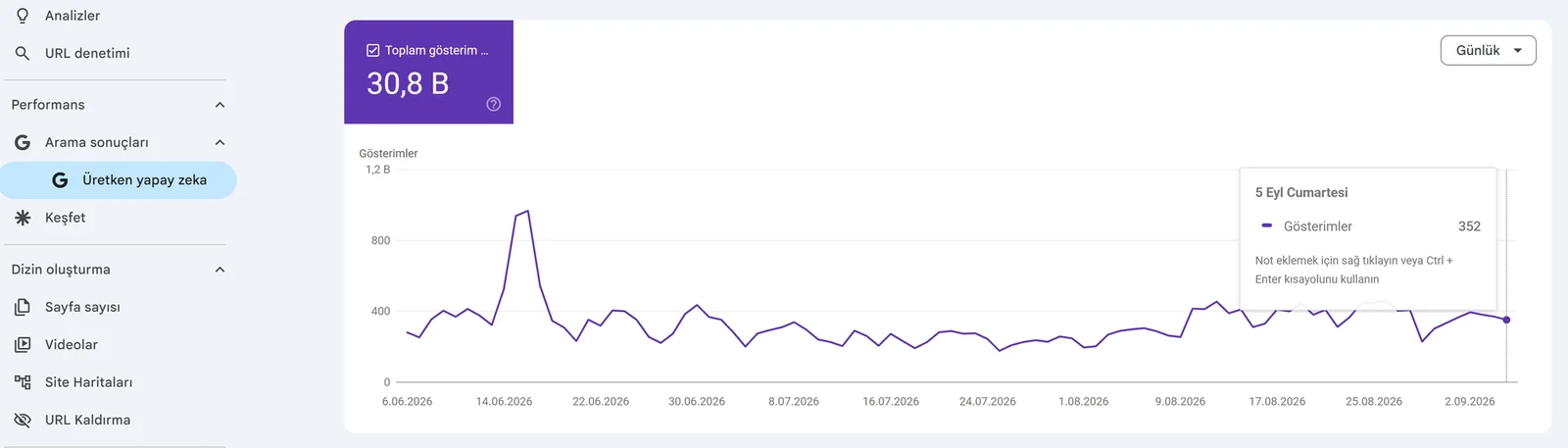
You will find it in Search Console under Performance, then Search results, in the row named "Generative AI." It reports impressions from AI Overviews, AI Mode and the generative features in Discover.
Our own numbers
Between June 6 and September 5, 2026, turksem.com recorded 30.8K impressions in generative AI features. A typical day ran between 250 and 450, with a spike toward a thousand in mid-June. We are publishing the figure so you have a reference point when you open your own report.
The limit of the report
You get impressions, pages, countries, devices and dates. Clicks, click-through rate and queries are missing. Google still will not tell you which question you appeared for. The only way to find out is to test your target questions on a fixed schedule.
Six Steps to Get Cited
Google says nothing special is required, and that is true. "Nothing special" is not the same as "nothing to do." This is the order we use on our own sites and for clients; the first item does the most work.
Six steps
- Put the answer in the first paragraph. The summary looks for a passage it can lift. The first two or three sentences of every important page have to carry the topic and the answer on their own. This article is built that way.
- Answer the sub-questions too. Query fan-out breaks the user's question apart. A page that covers most of the sub-questions also ranks for them. Ahrefs measured in January 2026 that such pages are cited 161% more often than pages answering only the main question.
- Describe your brand the same way everywhere. Your name, address and service description should match across your site, directories and the press. Inconsistency costs trust. Manufacturing mentions does nothing; Google's guide says so plainly.
- Do not pay for a slot on a "best of" list. If you write one, make the variable visible: a measured number, a stated criterion, a test you ran.
- Use the snippet controls deliberately. Close off anything you do not want in the summary with data-nosnippet. Keeping prices or contact details out of the summary can be the right call; the tags are below.
- Measure every month. The Search Console report gives you impressions; your own tests give you visibility on the questions that matter. Only the two together show what worked.
Our View: SEO, Google Ads, AIO and GEO
We do not sell the AI Overviews work as a separate service; it belongs to performance work. Our formula has not changed in years: SEO + Google Ads + AIO and GEO = results. For every SEO client, part of the budget goes to Google Ads, and the entire AIO effort runs inside the SEO engagement. Google put this work under SEO in its own guide; we said in early 2025 that we deliver it inside our SEO service.
The structure behind that: AI Overviews is one of two branches under the AIO umbrella. The other branch is GEO, being cited and recommended in the answers of generative engines such as ChatGPT, Gemini and Perplexity. Above both sits AIO with strategy, measurement, test loops and authority building. We counted which of the three acronyms people actually use in a separate article.
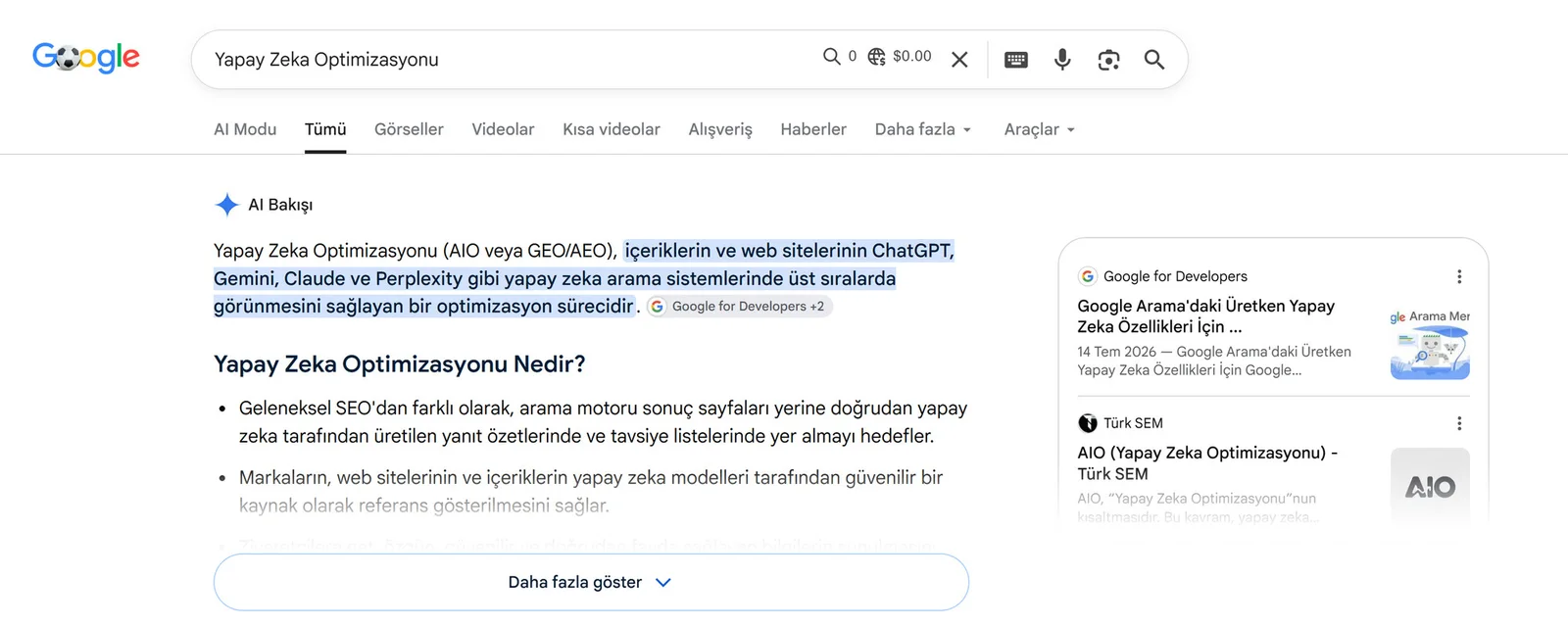
Rather than claim the approach works, we will show it. The screenshot below is Google's AI Overview for the query "Yapay Zeka Optimizasyonu," Turkish for AI Optimization. It cites two sources: Google for Developers and our own AIO page.
One detail in the screenshot
The summary treats "AIO or GEO/AEO" as one concept. Google's own guide names AEO and GEO but never AIO. The confusion is real, and we sorted it out on our AIO page. The message next to it matters more: when Google explains a concept, it picks our page as a source. That is the payoff of the principle we have argued for years: be answerable, stay consistent, write clearly enough to be quoted.
Can You Turn AI Overviews Off?
The question comes from two directions, so here are both answers.
As a searcher: pick the "Web" tab under the search bar and you get classic results only. Adding udm=14 to the URL gives you the same view; the parameter works per search, and saved as a browser search shortcut it applies every time. The summary does not disappear from Search; it just does not appear in that view.
As a site owner: nosnippet and data-nosnippet keep your text out of the summary. max-snippet limits how much of it gets used. On top of those sits the Search Console toggle described earlier, which removes your site from generative AI features altogether. Google says that setting is not a ranking signal for classic search; a site that opts out simply receives no impressions and no visitors from those surfaces.
Three tags, three lines
To keep an entire page out of the summary, in the head of the page:
<meta name="robots" content="nosnippet">To hide one section, a price for instance:
<span data-nosnippet>Promotional price: $4,500</span>To cap how much text gets used, here 50 characters:
<meta name="robots" content="max-snippet:50">Careful: opting out does not bring the clicks back
When you leave, the summary does not disappear. It still runs, with your competitor in the spot you gave up. Our advice is not to opt out but to be present: with accurate information in the summary and a page that earns the click. A page like that offers what the summary cannot, namely prices, examples, tools and firsthand experience.
In Short
What to take away
- Two antitrust suits are live, and a federal judge has called the arrangement "really unfair" from the bench.
- The opt-out that exists came from a UK order, not a US one, and it costs you the impressions along with the summary.
- It costs clicks: 8% versus 15% in Pew's data, and 38% less search traffic across 2,500 US publisher sites in a year.
- Sources come from the sub-questions, not from the top ten.
- Our observation: the system already has an answer in mind; accuracy and alignment with the evidence bring you closer to it.
- We do not buy placements on "best of" lists.
- Google counts this work as SEO and asks nothing extra of you.
- You measure it in the generative AI report, which does not show queries.
Frequently Asked Questions
Who Is Suing Google Over AI Overviews?
Chegg filed the first antitrust suit in February 2025. Penske Media, the owner of Rolling Stone, Variety, Billboard and Deadline, followed in September 2025. Both frame the issue as antitrust rather than copyright. Google moved to dismiss the Penske case, and the motion was argued before Judge Amit Mehta in August 2026.
Can Publishers Opt Out of AI Overviews?
Yes. Since June 2026, following an order from the UK competition regulator, a toggle in Search Console removes your site from AI Overviews, AI Mode and AI summaries in Discover. It also removes the impressions and traffic those surfaces send, so it is a trade, not a fix.
How Much Traffic Do AI Overviews Cost?
Pew measured clicks at 8% with a summary on the page versus 15% without. Chartbeat found organic search traffic across roughly 2,500 US publisher sites down 38% in a year. Ahrefs measured the click-through rate for position 1 falling 58% when a summary appears.
How Do I Get My Site Into AI Overviews?
Google's bar is two items: the page has to be indexed and eligible for a snippet. Beyond that, the evidence points to putting the answer in the first paragraph, answering the sub-questions, describing your brand consistently everywhere, and staying off paid "best of" lists. Length does not matter.
What Is the Difference Between AI Overviews and AI Mode?
AI Overviews appear on their own at the top of the classic results page. AI Mode is a separate tab that turns search into a conversation you can keep asking questions in. Both run on Gemini. AI Mode opened to every US searcher on June 27, 2025.
Is AI Overviews the Same Thing as AIO?
No. AI Overviews is a Google feature. AIO is the name of our AI Optimization methodology, and the AI Overviews work is one branch under it. The industry shortens the feature to "AIO" as well, which is where the confusion starts; our AIO page separates the two.