

Should you move part of your Google Ads budget to ChatGPT? Marketers keep asking me some version of that question. I didn't want to answer it with somebody else's case study, so we ran our own test.
The setup was modest: one Turkish-language ad for our agency, two weeks, and a budget that wouldn't buy a cup of coffee. Then I put the results next to our Google Ads search campaign. Here's what happened.
What We Tested (and a Disclosure)
The campaign ran September 24 through October 7, 2026. ChatGPT ads don't use keywords. You describe your audience in plain language, and ChatGPT matches the ad to conversations where it fits. So we wrote a few sentences about who we want to reach, and that was our targeting.
Full disclosure: we're a Google Partner agency, so we're not exactly neutral. That's why I'm letting the numbers carry this post.
Our ChatGPT Ads Results
- 88impressionsChatGPT Ads Manager
- 11clicksChatGPT Ads Manager
- 12.5%click-through rateChatGPT Ads Manager
- $0.53total spendChatGPT Ads Manager
Click-through rate (CTR) is the share of people who saw the ad and clicked it. At 12.5%, one in eight did. That's a strong number for any ad format.
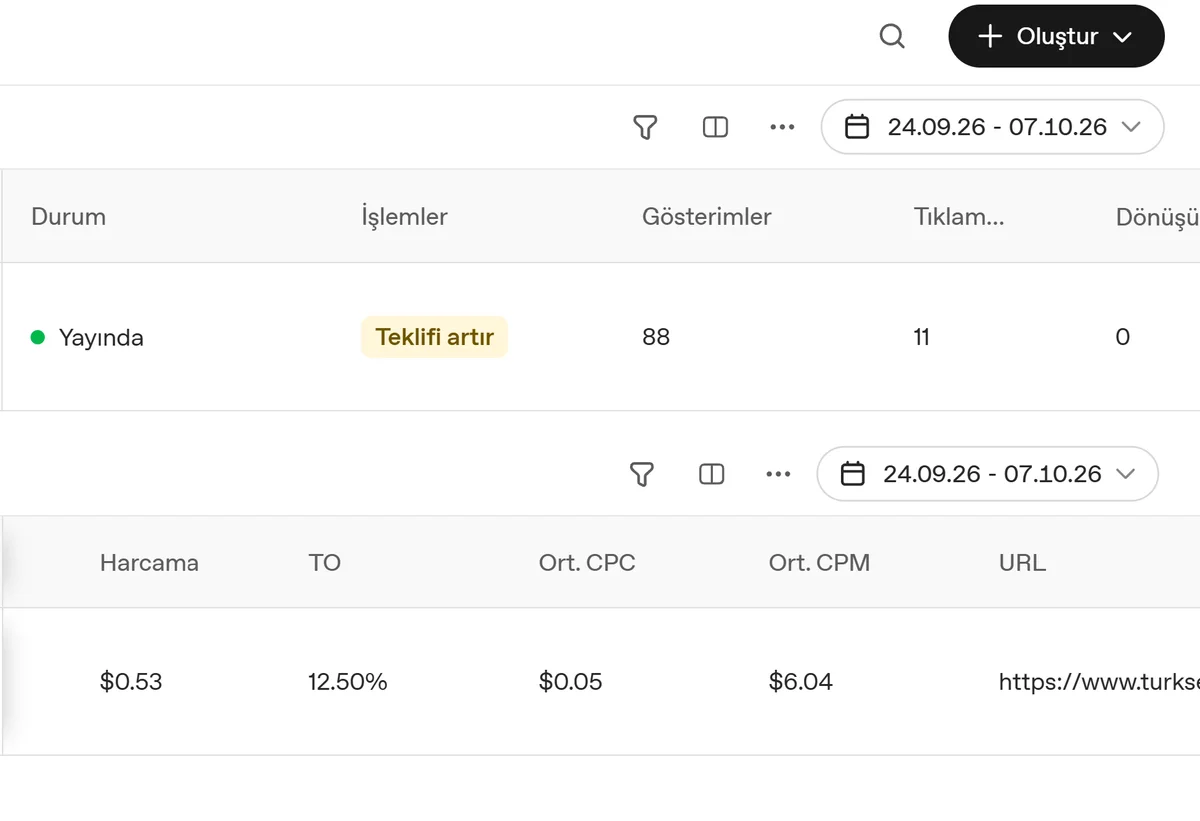
On average, we paid $0.05 per click and $6.04 per thousand impressions (CPM). Total spend for two weeks: 53 cents. Not exactly a big-budget launch, I know. But even a small test tells you something.
ChatGPT Ads vs. Google Ads: The Comparison
For a benchmark, I used our "Google Search SEO" ad group. Google bills that account in Turkish lira, so I converted at 50 lira to the dollar.
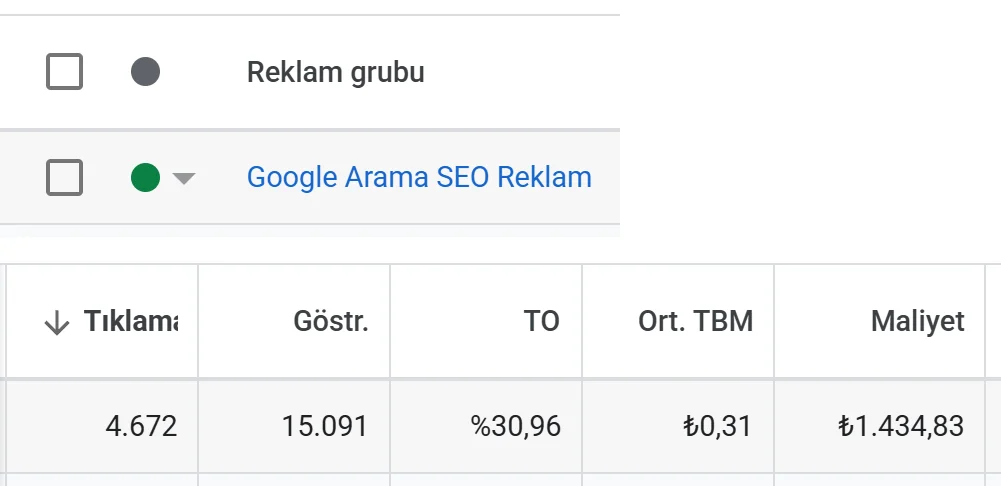
Side by side, it isn't close. A ChatGPT click cost about eight times as much as a Google click, and impressions cost about three times as much. Google's CTR was higher too: 31% against 12.5%.
A Google search is a request: the person typed exactly what they want, and your ad can be the answer. A ChatGPT conversation is about whatever the user brought to it, so your ad is an interruption, a relevant one at best. That's intent at work, and it's why I read our 12.5% CTR as a decent result rather than a weak one.
A note if you advertise in the US: search clicks in Turkey are cheap, and yours almost certainly cost far more than ours. So don't copy our cents; look at the ratio. Our Google Ads cost guide covers what clicks typically run.
How Much Can 11 Clicks Tell You?
Honestly? Not much. Treat it like a poll with 88 respondents: useful for a first read, too small to bet a budget on.
The margin of error
At 95% confidence, a true CTR anywhere from 7% to 21% would be consistent with 11 clicks on 88 impressions.
Statistics is how we run every campaign, and statistically, 11 clicks can't carry a verdict on ChatGPT ads. What they can show: no plausible CTR in that range brings ChatGPT's cost per click anywhere near Google's.
Who Sees ChatGPT Ads?
The US was the first market: OpenAI started testing ads there on February 9, 2026. Ads appear only for users on the Free plan and on Go, OpenAI's low-cost plan that sits between Free and Plus.
Plus, Pro, Business, Enterprise, and Edu users don't see ads. Neither do users under 18, and nobody sees them in a Temporary Chat.
According to OpenAI, ads don't change ChatGPT's answers, advertisers never see your conversations, and user data is never sold. Every ad is labeled and kept separate from the answer itself.
Why OpenAI Wants Ads
Start with the money, because it's moving fast.
OpenAI's own numbers
- ChatGPT Ads reached a $1 billion annualized revenue run rate in under 200 days.
- Tens of thousands of advertisers use the platform.
- ChatGPT has more than 1 billion weekly active users.
Source: OpenAI, August 31, 2026.
Who pays for all that free usage? Advertisers, through the ads shown on Free and Go. OpenAI is upfront about the trade: a free user who turns ads off gets fewer messages per day and loses tools like image generation, according to its help center.
With revenue climbing like this, my bet is that OpenAI keeps adding small ad placements, gradually.
What Happens After the Click? We Don't Know
We don't use cookies on our site, and we don't track visitors. That's a deliberate choice, and it has a cost: I can't tell you what the ChatGPT visitors did once they landed.
It's also why the dashboard shows zero conversions. A conversion is an action you count as a win, like a form submission or a phone call, and counting it takes a tracking tag on your site. We don't run one. So read that zero as a blank field, not a result.
Will We Offer ChatGPT Ads to Clients?
Eventually, yes. If the next round of tests goes the way we expect, we plan to add ChatGPT ads management in early 2027. Until then, we're not putting a single client dollar into it; we want our own experience on the platform first.
For reaching people at the exact moment they search, Google Ads is still the best tool we know. If you'd like a hand there, take a look at our Google Ads management.
FAQ
Can You Advertise on ChatGPT?
Yes. Businesses can sign up for OpenAI's self-serve Ads Manager at ads.openai.com. The company that advertises and gets billed has to be based in a supported country. The US came first, and the list of countries now covers much of Europe, the Middle East, and Asia, including Turkey.
How Much Do ChatGPT Ads Cost?
There's no fixed price. You set a budget and a bid. In our two-week test, we paid $0.05 per click and $6.04 per thousand impressions, but costs vary by market and by how much you bid.
Do Paid ChatGPT Plans Have Ads?
Only Go. Plus, Pro, Business, Enterprise, and Edu are ad-free.
Can You Turn Off Ads in ChatGPT?
Pay for Plus or Pro, and the ads are gone. Free users can switch them off too, at the price of fewer daily messages and fewer tools.
Do Ads Change ChatGPT's Answers?
OpenAI says no. The company says it doesn't take money to influence answers, keeps conversations private from advertisers, and doesn't sell user data.
Sources
OpenAI documentation
- Ads in ChatGPT, OpenAI Help Center.
- Ads Manager Availability, OpenAI Help Center.
- A milestone in expanding access to AI, OpenAI, August 31, 2026.


